Showing posts with label kawaii. Show all posts

Tuesday, 20 September 2016

What is Kawaii

from the google chrome response to search for 'kawaii'
Recently I received correspondence from artsy.net noting my references to kawaii in this blog, notably the cute figures here,  see also a train carriage here, asking me to comment.

My attention was drawn to an article here on the evolution of Kawaii in art from the 1970s.
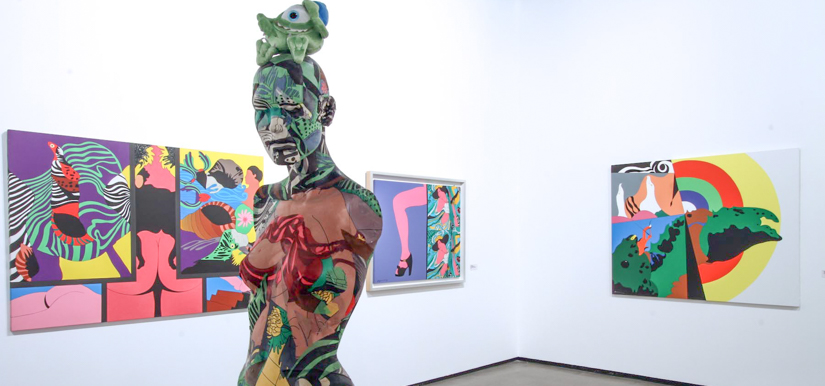
work of Yayanagi, not quite cute
I am conscious that while kawaii was emerging I was taken by a similarly hard edged but not cute style in the work of Yayanagi Go, two of whose works I acquired in the 1970s.

The work on the right is from an exhibition at the Instituto Tomei Ohtake in Brazil.

You will see some link to Yayanagi's individual style in this work of Takashi Murakami at Artsy.

The term kawaii was not however new in the 1970s, though Hello Kitty was certainly new then. Wikipedia traces the term to Lady Murasaki in the eleventh century and says that:
The original definition of kawaii came from Lady Murasaki's The Tale of Genji where it referred to pitiable qualities.[9] During the Shogunate period under the ideology of neo-Confucianism, women came to be included under the term kawaii as the perception of women being animalistic was replaced with the conception of women as docile.
So it's historically not an entirely flattering term.

Wikipedia goes on to explain the modern phenomenon as arising from schoolgirls beginning to write across the page and with modern pens, interspersing drawings. Among early shifts from the page to other forms was to cute pencil cases. This is a google search for Japanese pencil cases 1979.

It's reasonable to think that others shared my view of the triviality of kawaii as it emerged.

There has also developed a worldwide appetite for Japanese anime, an art form with some links to kawaii but going far beyond the cute.

It seems to me that Kawaii has deeper roots, not just some spontaneous shift in the 1970s. Take for example work of Kamisaka Sekka, 1866-1942.
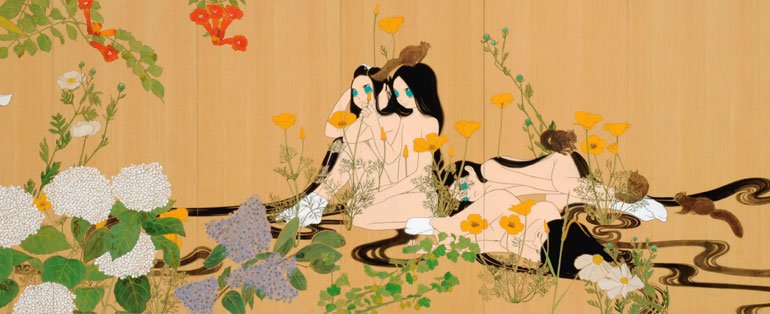
from http://www.artgallery.nsw.gov.au/exhibitions/kamisaka-sekka/

from https://en.wikipedia.org/wiki/Kamisaka_Sekka

from http://alchetron.com/Kamisaka-Sekka-1217229-W
Compare with the kawaii work of Yoshimoto Nara at Artsy, which definitely brings in a naive school pad doodle quality with a common tendency to English language and cultural borrowings.


The wearing of western style school uniforms dates from the Meiji era.  The shortening of skirts came in in club wear in the early 1970s from the European miniskirt. The fetish combination of short skirt and maid uniform more recently, notably as driven by Akihabara. But fetish is something else, otaku, which overlaps a bit with kawaii.

from http://www.gourmantic.com/2009/07/28/maid-in-tokyo/
There is in some of this (though not in all anime) a peaceful or childlike quality which may also have been a factor (I speculate) in the rise of this as acceptable 'new' art form in postwar Japan in a time when young women sought more freedom, though the art form itself may somewhat trivialise them. Also compare to the much more difficult art form of apprenticing as a geisha, the apprentices called maiko. People rush to photograph maiko in Gion, Kyoto in the evening, here images at Pinterest. Simplified stylisation and minimal gesture are of long standing in Japan, in contradistinction from mainstream European art. In collision and synthesis with postmodern, all the rest is commercial success...

Another perspective, 29 kawaii things, from the excellent Japan Talk website.


We cannot leave this subject without mention of music and without medicine from Cibo Matto.


or mention of Koenji, our favourite village of Tokyo
where evident that kawaii need not be seen as a cutesy separate thing 
but integrated into a culture of innovation


Thursday, 24 April 2014

Day 5, Tokyo Sunday, part 2: subway, Sendagi, Yanaka

After the wild and crowded life thrust upon us exiting Harajuku Station and around Yoyogi Park, during which my Fuji XF-1 camera decided to lose control of exposure (hereinafter photos mainly from iPad mini, fortunately on hand), we set off down Omotesando, imagining it to have the serenity and charm it had when I walked there in 1980. It doesn't.

We slipped into the first subway entrance, Meiji-Jingumae, of the Chiyoda Line.

Helen caught this stunning image of modern Japan going out or going home...


The sweet lolita subset of kawaii of Harajuku Sunday World above was wafting in...


I could see from the subway map (it really does help to try to understand it in advance) that we could take this chanced-upon Chiyoda Line to a station near Nippori, from where swiftly on the Yamanote Line to Ueno, then the Ginza Line to Tawaramachi, then 300 metres walk home past our preferred sushi shop. This screenshot below is the middle bit of a standard map. To orient yourself, remember that the Yamanote Line of Japan Rail (this is a fantastic introduction to the villages/cities of the Yamanote Line) runs around the centre of the city, and while the carriages are pleasantly light green on the outside and lightv green in railway station signs, on the map it's the grey and white dotted line. So... in the moment I discover we are at the ticket gate of the Chiyoda Line at C03, Meiji-jingumae, south from Shinkuku, the world's biggest train station, we are down in the lower left of the map. Follow the green line with the C numbers and you are following the Chiyoda Line. I decided we should walk to Nippori JR station from Sendagi because that seemed likely to lead through Yanaka, an area with a 'traditional' shopping street of which I had read. Sendagi is C15. See Nippori north east from it, Ueno two stops away on the Yamanote, Tawaramachi G18 on the Ginza Line from Ueno, orange line. Top right. It was nice taking this ride on Sunday afternoon, Wikipedia reports that on the north side of Nishi-Nippori at peak hours passengers may be at 180% of capacity.


Soon enough we joined the Sunday afternoon crowd on Chiyoda Line, doing what respectable people do on the subway in the afternoon.


Helen woke me just before we arrived at Sendagi!

Arriving at the surface from a subway station on an overcast day can be tricky in any city, you take multiple flights of stairs or escalators, turning a number of times, you hit the street, blindfold comes off so to speak and where's north you say to yourself. It was where I thought. We were in a very suburban, residential environment. I confirmed from a passing cyclist that from the gate we should go left then right for Nippori.

As seen from Google Earth, Sendagi Station lower left, Nippori Station top right.


Proceeding left, we looked up a lane in the wrong direction and had to go there. This was a perfect quiet counter to the crowded parks and streets at better known destinations. Sudo Park, green spot left side of map above, bliss for young person with mother and soft serve below.

Shhh... tiptoe away....


This photo also makes the point that after cherry blossoms come azaleas, after azaleas wisteria.

===
We proceeded through minor streets for what I understood to be Yanaka, a traditional merchant street leading to Ueno.

This is what we found.

the pot plant is on the back rack of the motor scooter


in narrow streets glass windows add dimension


There are children in strollers, below, but dogs very commonly get to avoid exercise this comfy way, even biggish dogs

Not much leg, but I walk

looking back where we have just come from: the Yanaka ginza


The shrines that are not tourist tramped, where people go for spiritual purpose, are so much more interesting to pass...


and then two stops to Ueno

The signs say reserved for people with babies, pregnant people, old geezers and walking wounded
... and don't use your phone near such people.
The frequent supporting public address announcements say please too.  :-)
But the train was not full and on most rides many people
would leap to their feet anywhere in the carriage for those needing a seat.
Women with babies refused to take my seat, insisted I take theirs. I must look decrepit!
It's great to be in a smiling courtesy contest.
then we hurried down below from JR Ueno to Ginza Line G16, where we queued properly for Car 5.
Footpaths and stations have lots of yellow pimpled pavers, much support for vision impaired.
There would be longitudinal grooves if one were to walk along a yellow line.
These yellow pavers calls halt.


Wednesday, 16 April 2014

Day 7: forest, water, nostalgia and a tiny west coast Italian restaurant

I placed another account of this trip with more detail on the trains with this movie at YouTube.

The movie is made on iPad Mini, my regular camera having taken leave of its sensors... and the film was assembled using iMovie on the iPad, a perverse process somewhat akin to assembling a sailing ship in a bottle, plus involuntary rattlesnake noises added by some creature at Apple who designed this cut-down app... along with involuntary "Ken Burns Effects", the seasick effect of photos zooming out and in. 


An astonishing day. Planned but even though planned, worked very well. Though complex, did not break down. This written aboard Shinkansen Max Toki sitting waiting for departure at 2019 from Niigata for Ueno. We have travelled 360kms on four trains to get here, not seen a non-Japanese person all day. And have just topped off the day with a delicious Italian meal, as organised by phone from home by Emiko our house minder (along with David and Ralph). Now to rush home on the bullet train, 123 minutes to cover 330.3kms


We took the 8am Tubo Limited Express Kinu from Asakusa to Kinugawa. At Kinugawa, we did that wonderfully Japanese thing of rushing train to train, trains being invariably precise and people being given in this case from arrival 0959 to departure 1001, the easy bit being that the second train was across the platform, the slightly complicating bit being that we were in car five of six arriving needing to get on a two car (one red, one white) diesel, way up there. 


We scrambled in the back door of the second, red, car, to discover that it was the plush lounging car, already occupied, among the pot plants, by a cheerful indeed garrulous gang of mature locals, beers in hands, at 10am, life living. We moved on to the less populated white with blue velour car, with its own pot plant in front window. Disbelieve if you dare, go watch the movie! This is, after all, the daily two car workhorse of the Yagan Railway and Aizu Railway.


A wonderful trip up through mountain country....


Parenthetical: the train inspector of tickets just went by on this Shinkansen, as it charges through the night and I can still write. As is entirely routine thing on Japanese trains, he turned and bowed  for a moment to the carriage before disappearing. Train shift teams also, I observed today, bow to each other on handing over.  The land of the courteous, the dignified and respectful.


Back to story... We stopped for an hour between trains at Yunokamionsen. The only station in Japan with a thatched roof, perhaps the only one with an open fire? Surely the only one with a thatched roof, an open fire AND a foot onsen with hot alkaline water to soak toes (see video).


The Aizu trains and stations have embraced kawaii [cuteness] wholeheartedly.


Important to note that these small trains despite size had beautifully appointed and immaculate toilets. Public toilets, railway toilets especially, have great variety in ingenious design. Well, the same basic elements of squat or swirl, but after that... Will keep for separate story.
The 1230 single car train for Aizuwakamatsu was very much a local, stopping at every stop, Interesting people, interesting country,with snow on hilltops... Alas up in these mountains no cherry blossoms. For the most part rice fields still winter bare, just a few beginning preparations.


Aizuwakamatsu is hard to describe. We walked but got to see mainly that if we had time and inclination to walk further we just might see something. A bit like being plonked in a back street of Gouburn Helen thought.


We got back early for the departure of the 1433 Banetsu West train. It came in early and of course we all rushed for seats. Two cars of seats between two dozen people. Setting off with snow on mountains, approaching mountains. Inside the train, as on the Aizu train, wonderfully warm, on this occasion windows that could be opened to provide a welcome jet of fresh air. 


This rail line from Aizuwakamatsu to Niitsu and Niigata is, according to Wikipedia also know as the water, forest and nostalgia train. The film may show that title is deserved. Having for most of the trip looked filmed snoozed among about seven passengers altogether,


The character of the trip changed totally as we approached Niitsu and Niigata, into the world of afternoon commuting. At Niitsu we had the luxury of a five minute gap between trains, pelting up and down stairs with a mob from platform 1 to platform 4 and impressed now to get aboard an altogether bigger and very serious train after the deilghtful rides on little trains stopping-starting at tiny places through the wild.


I had not known what character to expect in the city of Niigata. It was evident when we got there that we could have chosen from a thousand restaurants. But curiously google maps had drawn me to a place  called Piatto Giorno (Italian for dish of the day) several weeks ago. And I had asked Emi to call from Australia on my Skype account and see whether they could meet Helen's diet needs. Which the chef said he would happily do.


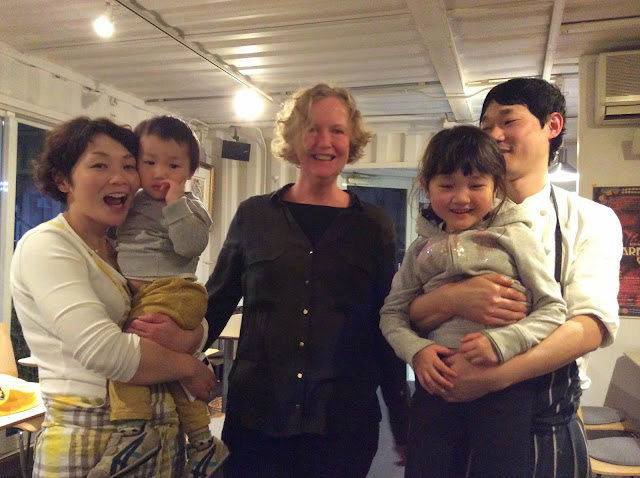
And so we walked, aided by a gross google map on paper and by nice advice from a gentleman walking home the way we were going, through the sea-damp dusk of Niigata, to find Piatto Giorno. To walk through Niigata was a great pleasure. After leaving the built up area around the station we were on quiet streets with substantial dark serious houses. The air was damp and cool and full of the smells of deep cold sea. The family who own and run Piatto Giorno, mother and father and two young children, came running out the door with smiles to greet us. 


They had prepared our places at a table and also placed there an English translation of their daily menu chalk board.


Such a nice welcome, such a great meal.


-----


Now flying for Tokyo, 320km, two hours three minutes, from 2019 to 2222 hours, a train not to mess with. Double decked Shinkansen Max Toki. (it sounds fierce just to say it: "SHIN-KARN-SEN all short sharp and loudly MUCKS TOKKY!" Alongside me as I blog a young slim businessman works in endless spreadsheets of his day's business. I am just on holiday, but this is a serious working train. 

BELOW: Queueing for reserved seats, 2006 hours, thirteen minutes before departure,  train still closed while cleaners clean and computers rotate seats... perhaps an internalised apprehension of being left behind. 


FOOTNOTE [haha]

This is where to stop if the bell is telling you there is a train coming at the open crossing at Yunokamionsen.